
The Heifetz and Linsky Adaptive Leadership Model: Why You Sometimes Need to Leave the Dance Floor and Stand on the Balcony

You are in a meeting. Someone challenges your suggestion. Before they have finished speaking, you are already preparing your defence.
You remember all the hard work that went into it. You notice their tone. You may even wonder why they always seem to do this in front of other people.
You respond. They push back. Someone else joins in, and before long a conversation about a proposal has become a conversation about competence, credibility and who gets to decide.
And you are right in the middle of it.
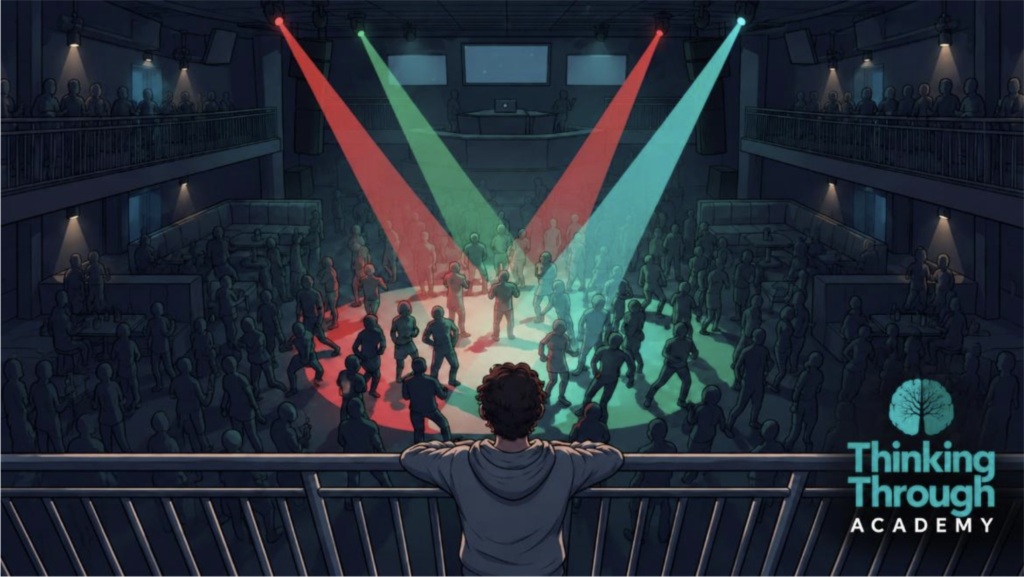
The Heifetz and Linsky adaptive leadership model offers a useful image for moments like this: move from the dance floor to the balcony. In this article we look at where the model comes from, what it means in practice, and why the brain science of stress helps explain why stepping back is so hard, and so valuable, when the stakes are high.
What is the Heifetz and Linsky adaptive leadership model?
Adaptive Leadership is a framework developed by Ronald A. Heifetz, a psychiatrist and founding director of the Center for Public Leadership at Harvard Kennedy School, and his long-time colleague Marty Linsky. Heifetz first set out the ideas in Leadership Without Easy Answers (1994). He and Linsky developed them in Leadership on the Line (2002), and later, with Alexander Grashow, in The Practice of Adaptive Leadership (2009). Heifetz and Linsky also co-founded Cambridge Leadership Associates to take the approach into organisations around the world.
The starting point is simple. Leadership is not the same as authority. Ron Heifetz describes leadership as mobilising people to tackle tough challenges and thrive, whether in a business, the public sector or wider community life. That means leadership is an activity anyone can take on, not a job title. (If you want to explore that distinction further, see our article on the eight differences between management and leadership.)
Unlike many Leadership & Management Style Frameworks, such as situational leadership theory or transformational leadership, the Heifetz and Linsky adaptive leadership model is less about which style you use and more about what kind of problem you are facing.
Technical problems versus adaptive challenges
At the heart of the model is a distinction between two kinds of problem.
Technical problems can be solved with existing knowledge. The problem is clear, the fix is known, and an expert or someone in authority can apply it. Technical leadership, getting the right expertise to the right problem, is exactly what is needed here.
Adaptive challenges are different. There is no ready-made answer. Solving them requires people to learn, to change their beliefs, habits or loyalties, and often to give something up. Think of a team learning to work alongside generative AI, a council redesigning services with a smaller budget, or an NHS department trying to shift a long-standing culture.
|
Technical problems |
Adaptive challenges |
|
|
The problem |
Clearly defined |
Hard to define; people disagree about what it even is |
|
The solution |
Known, or findable by an expert |
Requires learning; nobody has the answer yet |
|
Who does the work |
The person in authority or the expert |
The people with the problem |
|
What has to change |
Processes, tools, systems |
Values, beliefs, habits, loyalties |
|
Example |
Fixing a broken rota system |
A team that keeps over-promising and under-delivering |
According to Heifetz, the most common leadership failure is treating adaptive problems as if they were technical challenges. A new process gets rolled out, a restructure is announced, a training day is booked. Then everyone wonders why nothing has really changed.
Symptoms of adaptive challenges
How do you know you are facing adaptive change rather than a technical fix? Some common symptoms of adaptive challenges include:
- The same problem keeps coming back, however many times it is “solved”.
- Previous fixes have not worked, or have worked only briefly.
- People disagree about what the problem actually is, not just how to solve it.
- Conversations become emotional, defensive or political quickly.
- There are signs of resistance to change, even from people who say they support it.
- The issue cuts across departments, values or loyalties.
In a 2009 Harvard Business Review article, Heifetz, Grashow and Linsky argued that many organisations now operate in a state of permanent crisis, where adaptive challenges are the norm rather than the exception. That makes the ability to recognise them one of the most useful leadership skills and insights you can develop.
Heifetz’s six principles of adaptive leadership
In “The Work of Leadership”, a 1997 Harvard Business Review article with Donald Laurie, Heifetz set out six principles to lead adaptive change. They remain a practical summary of the model:
- Get on the balcony. Step back from the action to see patterns, not just events.
- Identify the adaptive challenge. Diagnose whether this is a technical or adaptive problem before rushing to solve it.
- Regulate distress. Keep the pressure high enough to motivate change but not so high that people are overwhelmed. Heifetz calls the space that makes this possible a holding environment: a set of relationships, structures and trust that lets people stay with difficult work.
- Maintain disciplined attention. Notice when people avoid the hard issue through blame, distraction or endless debate, and bring the focus back.
- Give the work back to the people. Resist the urge to solve everything yourself. The people with the problem need to own the learning. Our article on the coaching leadership style explores what this looks like day to day.
- Protect voices of leadership from below. The people raising awkward questions are often the ones seeing the problem most clearly. This links closely to democratic leadership and to distributed leadership, where responsibility for change is shared across the organisation.
The rest of this article focuses on the first of these principles, because without the balcony it is very hard to do any of the others well.
The dance floor and the balcony
The dance floor represents the thick of the action. When you are on the dance floor, you are participating, managing day-to-day tasks, engaging with the noise and immediate pressures, and feeling the emotional heat. Staying there permanently blinds you to broader systemic issues.
The balcony represents a more detached, elevated vantage point. From the balcony, you step away from the chaos to observe patterns, group behaviour, power dynamics and the direction of the overall system. It is where strategic reflection and objective diagnosis happen.
It is an image with a useful connection to how we think under pressure.
When you are on the dance floor, you can feel every bump. From the balcony, you may begin to understand why people keep bumping into one another.
Why perspective becomes harder when we need it most
The dance floor demands your attention.
There are immediate decisions, competing voices, deadlines and consequences. You need to listen, interpret, respond and keep track of what is happening.
Add a sense of threat, perhaps to your reputation, authority or belonging, and that work becomes harder still. This is especially true in high stakes, challenging environments such as healthcare, policing and public leadership roles.
Research tells us that stress can impair working memory and the regulation of attention, both of which depend partly on the prefrontal cortex. These abilities allow us to hold information in mind and guide our responses. The effects vary with the intensity and context of stress, and pressure does not affect everyone in the same way. If you want to read more, Professor Amy Arnsten’s review of stress and prefrontal function is a good place to start, and our Neuroscience of Leadership programme explores what this means for leaders in practice.
In an everyday conversation, that can feel like having less room to think. The challenge occupies our full attention, and other information slips out of view.
You hear the objection but miss the less obvious uncertainty behind it. You notice the interruption but overlook the fact that three people have been trying to raise the same concern. You concentrate on making your point and lose track of what the group needs to resolve.
This is one reason “just be more thoughtful next time” can be such an unhelpful instruction in a heated moment. Learning to manage your own reactions, through self-regulation and practical tools like those in our Stress Mastery course, makes it far easier to get onto the balcony when it counts.
We may need to change our vantage point before we can change our response.
The balcony creates psychological distance
There is a psychological process that helps explain part of this metaphor: self-distancing.
It involves looking at an experience from a more removed perspective, for example by imagining how an observer would describe it. It is closely related to emotional intelligence: noticing what you are feeling without being completely driven by it.
Instead of only asking, “Why are they doing this to me?”, you might ask, “What is happening between these two people?”
Research on psychological distancing suggests that it can reduce the emotional impact of negative experiences. Brain-imaging studies associate it with activity across networks involved in cognitive control, perspective-taking and reflection. The findings point to a distributed process rather than a single “balcony centre” in the brain. There is further reading here if you want it: a review and neuroimaging meta-analysis of distancing. For a wider look at how brain and mind research fit together, see neuroscience vs psychology.
Figure 1. Distancing as a tactic of cognitive change within emotion regulation. Source: Powers & LaBar (2019), linked above.
Heifetz and Linsky’s balcony is, of course, a metaphor. Laboratory studies of distancing do not prove that a particular leadership practice will improve every meeting. But they give us a plausible reason why changing perspective can help when we are dealing with difficult situations or thorny problems.
Sometimes we need to call a halt so that everyone can step away and regain a measure of perspective, a bit like the cooling-off period after a sales call.
A situation may feel different when you stop viewing it exclusively through your immediate involvement in it. You can still care deeply about the outcome. You simply have more than one way to understand what is happening.

A different view produces different questions
Back in that meeting, your first interpretation might be: They are undermining me. A balcony perspective allows you to examine that interpretation:
What did they actually say?
Which part am I treating as a judgement about me?
Is their concern about the idea, the timing, the resources or the way the decision is being made?
Has the conversation become a contest over who is right?
What am I contributing to that pattern?
That last question is often the most uncomfortable, because the balcony brings your own behaviour into view.
Perhaps you have been answering every concern so quickly that people feel dismissed. Perhaps your confidence has sounded like certainty. Perhaps you asked for feedback when you were really hoping for agreement. If you are not sure how you tend to come across, our guide What Is My Leadership Style? is a useful place to start.
You might also discover that your original concern was well founded. Someone may indeed be behaving unfairly.
Perspective is an interesting thing. It does not require you to invent a kinder explanation for everything. It helps you distinguish what you have observed from what you have inferred, so that your response rests on firmer ground.
Looking for the pattern around the incident
Imagine a team that repeatedly misses deadlines.
On the dance floor, each missed deadline becomes an urgent problem. The manager chases an update, rearranges work and steps in to finish the task. Everyone eventually gets through another difficult week, and their enthusiasm for coming into work the following Monday morning takes another knock.
From the balcony, the manager might notice a recurring sequence:
Work is agreed before capacity is discussed. People hesitate to challenge unrealistic commitments. Problems surface late. The manager rescues delivery.
Each intervention makes sense on its own. Together, they may help the pattern continue. This is a classic adaptive problem dressed up as a technical one.
If rescue is dependable, the team has less reason to make constraints visible early. If raising concerns feels uncomfortable, optimistic promises remain easier than honest negotiation. Over time, this becomes part of the organisational culture.
The balcony question becomes: What keeps producing this outcome?
That question opens up different actions. Rather than one big change management programme, the manager might try a few small, safe-to-fail experiments: changing how commitments are agreed, inviting concerns earlier, or making trade-offs explicit. In Heifetz’s terms, this is giving the work back: the team learns its way to a better pattern instead of the manager carrying it. Over time, that builds the team’s adaptive capacity.
The work still needs to be done. But a wider view helps you identify where effort could make a lasting difference.
Make the balcony easy to access
Getting onto the balcony need not mean leaving the room or scheduling an hour of reflection.
Sometimes it is a pause before replying. Sometimes it is writing down a question while someone else speaks. Sometimes it is asking for a short break because you can feel the conversation becoming less useful.
Personally, if things are getting heated, I am a big fan of calling a pause so everyone can take a quick break. Ten minutes to move about, grab a cuppa or visit the bathroom creates space for people to think and regroup.
A practical sequence is:
- Notice your involvement. “I am becoming defensive.” “I am rushing to solve this.” “I really want to win this point.”
- Describe the scene. Use observable details: “Two people are interrupting each other.” “We have returned to the same disagreement three times.”
- Widen the question. “What concern have we not understood?” “What pattern am I helping to maintain?”
- Choose your return. Decide on one useful next move.
That move could be a question: “Before I respond, which part of the proposal worries you most?“
It could be an observation: “We seem to be discussing delivery dates before we have agreed what we can realistically take on.“
Or it could be an acknowledgement: “I can hear that I have been defending the plan. Let me check that I understand your concern.“
These are ways to bring what you noticed on the balcony back into the conversation. Many of them are everyday coaching skills, which is why our Coaching at the Front Line course focuses on exactly these kinds of conversations.
Reading the signs of resistance
In Leadership on the Line, Heifetz and Linsky are honest about the organisational dangers of leading change. When you ask people to face an adaptive challenge, you are asking them to tolerate loss, and resistance to change is a natural response. They describe four common ways people push back against someone exercising leadership:
- Marginalisation: the person raising the issue is sidelined or labelled as “difficult”.
- Diversion: attention is pulled onto something else, often something more comfortable.
- Attack: the focus shifts from the issue to the person, their character or their competence.
- Seduction: praise, loyalty or a sense of being “one of us” draws people away from the hard work.
Spotting these signs of resistance is much easier from the balcony. On the dance floor, an attack feels personal. From the balcony, you can see it as part of the change work, and respond to the issue rather than the heat. Building your own resilience helps you stay steady while that happens.
The view still needs checking
There is a trap in this metaphor, and it is worth naming. Once you have stepped back, it is easy to believe you can see the whole picture. You can’t.
Your balcony view is still shaped by your past experience, assumptions and the information you have. Distance may reveal a pattern, but it may also hide details that matter to someone on the floor.
Treat what you see as a hypothesis.
“I wonder whether people are reluctant to raise concerns early” is something you can explore with the team.
“This team is avoiding accountability” is a verdict that may close the conversation before you understand it.
Useful perspective remains curious. It makes room for other people to tell you what you have missed.
Then return to the dance
Reflection becomes valuable when it changes participation.
You still need to make decisions, have difficult conversations, meet commitments and take responsibility for your part in events.
If your next step is a difficult conversation, our article Why Difficult Conversations Feel So Difficult explores why feedback can trigger defensiveness and offers a practical structure for approaching it with clarity and curiosity.
Taking a balcony view can help you prepare. The next step is to bring that perspective into the conversation.
The practice is a movement between involvement and observation.
Participate. Notice. Step back. Check your interpretation. Return with a more deliberate response.
Sometimes the next step will be to act quickly. Sometimes it will be to listen longer. Sometimes it will be to stop rescuing a pattern that needs to change.
The balcony helps you choose.
Building adaptive capacity in your organisation
The Heifetz and Linsky adaptive leadership model is not something you master in a single workshop. It is a practice that deepens over time, and it works best when it is part of wider Leadership Development rather than a one-off.
At Thinking Through Academy, our leadership training courses combine applied neuroscience with accredited qualifications, helping leaders understand what happens in their own brains, and in their teams, when the pressure is on. Depending on where you are in your career, you might start with:
- ILM Level 5 in Leadership and Management, for managers ready to move from running a team to genuinely leading one.
- ILM Level 6 or ILM Level 7 in Leadership and Innovation, for senior leaders steering organisations through deep change.
- ILM Level 5 Coaching and Mentoring, for leaders who want to give the work back through coaching conversations. Our article on becoming a coach or mentor explains more.
- Women in Leadership, for women who want to lead with confidence in their own way.
- Leadership coaching, one-to-one or in groups, to work through your own adaptive challenges with an experienced coach.
- Lunch and learn sessions, a low-commitment way to introduce ideas like the balcony and dance floor to a whole team.
If you are planning a wider programme, our guide on how to create a leadership development plan is a good starting point. You can also download our programme guide, browse the full range of ILM courses, or listen to the Neuronuggets podcast for bite-sized brain science.
Want to talk about building adaptive capacity in your team? Get in touch and we will be happy to help.
The next time you feel pulled into a familiar argument, pause long enough to ask: If I were watching this from the balcony, what would I notice, including about myself?
Then ask: What would that help me do next?
You may discover that you have been working very hard on the next step while missing the shape of the dance.
Frequently asked questions
What is the Heifetz and Linsky adaptive leadership model?
It is a leadership framework developed by Ronald Heifetz and Marty Linsky at Harvard Kennedy School. It distinguishes technical problems, which experts can solve, from adaptive challenges, which require people to learn and change. Leadership, in this model, means mobilising people to do that adaptive work.
What is the difference between technical and adaptive challenges?
Technical challenges have a known solution that someone with the right expertise can apply. Adaptive challenges have no ready-made answer and require changes in values, beliefs or behaviour from the people involved.
What are Heifetz’s six principles of adaptive leadership?
Get on the balcony, identify the adaptive challenge, regulate distress, maintain disciplined attention, give the work back to the people, and protect voices of leadership from below.
What does “getting on the balcony” mean?
It means stepping back from the immediate action, the dance floor, to observe patterns, relationships and your own part in what is happening, before deciding how to respond.
Which books explain adaptive leadership?
The three key texts are Leadership Without Easy Answers (Heifetz, 1994), Leadership on the Line (Heifetz and Linsky, 2002) and The Practice of Adaptive Leadership (Heifetz, Grashow and Linsky, 2009).

Responses