
What is the Hersey and Blanchard Situational Leadership Model?


When you manage a team, you know that no two situations are the same. Some people need clear direction, while others thrive when given freedom to take ownership. The Hersey and Blanchard situational leadership model is a framework that helps you adapt your leadership style to the competence and commitment of those you lead.
Instead of relying on one fixed approach, this model shows you how to shift between giving instructions, offering support, coaching through challenges or stepping back to delegate. By understanding both leadership styles and follower maturity, you can match your approach to the needs of each situation.
Here, our leadership experts will take you through the Hershey and Blanchard situational leadership model and how you can apply it to your management role.
Core Concepts of the Hersey and Blanchard Situational Leadership Model
This leadership framework shows you how to adjust your management style to match the skills and readiness of the people you lead. It highlights the link between task demands, follower development, and leadership adaptation instead of promoting a single best way to lead.
Defining situational leadership
Situational leadership is based on the idea that no single leadership style works in every case. Instead, you adapt your approach depending on the competence and commitment of your team.
Dr. Paul Hersey and Ken Blanchard called this the life cycle theory of leadership, which later became known as the Hersey and Blanchard situational leadership model. It focuses on two main behaviours: task behaviour (how much direction you give) and relationship behaviour (how much support you provide).
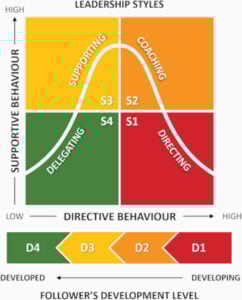 The model identifies four leadership styles:
- S1 – telling/directing: high task focus, low relationship focus.
- S2 – selling/coaching: high task focus, high relationship focus.
- S3 – participating/supporting: low task focus, high relationship focus.
- S4 – delegating: low task focus, low relationship focus.
Hershey and Blanchard discuss followers in their model, and these followers will be your team members. Each style fits a different level of follower readiness, which ranges from low competence and commitment to high competence and confidence.
Origins and history
The model was first introduced in the late 1960s by Paul Hersey and Ken Blanchard. Hersey later expanded on it in his book Situational Leader, while Blanchard developed a revised version known as situational leadership II (SLII).
At the time, many leadership models promoted fixed traits or behaviours. What made this framework different was its focus on flexibility. Leaders were encouraged to move between styles depending on the situation rather than stick to one method.
The life cycle theory of leadership was the original name, reflecting the idea that followers move through stages of development. As people gain skills and confidence, the leader’s role shifts from directing to delegating. This practical approach helped the model gain wide use in business, education and the military.
Key principles and dimensions
The model rests on two core dimensions: leadership style and follower readiness. Leadership style reflects how much direction and support you provide. Follower readiness reflects the ability and willingness of your team members to complete a task.
Hersey and Blanchard described four readiness levels:
| Readiness level | Description |
|---|---|
| R1 | Low competence, low commitment |
| R2 | Low competence, high commitment |
| R3 | High competence, variable commitment |
| R4 | High competence, high commitment |
The aim is to match your style to the readiness level. For example, you might use S1 telling with someone at R1, but S4 delegating with someone at R4.
This flexibility helps you avoid over-managing skilled employees or under-supporting those who need guidance. It also shows how leadership adaptation is not about personality but about meeting the needs of your team in a given context.
Leadership styles and follower maturity
Effective leadership depends on how well you adjust your approach to the skills and motivation of your team. The Hersey and Blanchard model shows that both leadership style and follower maturity need to align for tasks to be completed successfully.
The four leadership styles in more detail
The model identifies four leadership styles based on how much directive behaviour and supportive behaviour you provide. Each style is suited to followers at different stages of development.
- Telling (S1) – high direction, low support. You give clear instructions and closely supervise tasks.
- Selling (S2) – high direction, high support. You explain decisions, encourage input and build confidence.
- Participating (S3) – low direction, high support. You share decision-making and focus on motivation.
- Delegating (S4) – low direction, low support. You trust capable followers to work independently.
These styles are not fixed. You must shift between them depending on the readiness of your team members. For example, the telling style is useful with new recruits, while the delegating style fits experienced and committed staff.
Understanding maturity levels in more detail
Follower maturity describes how prepared someone is to take on a task. It combines task readiness (skills and knowledge) with psychological readiness (confidence and motivation).
The model defines four maturity categories:
- D1 Followers – low competence, high commitment. They are eager but lack ability.
- D2 Followers – some competence, low commitment. Skills are developing, but confidence may drop.
- D3 Followers – high competence, variable commitment. They can perform well but may lack motivation.
- D4 Followers – high competence, high commitment. They are skilled, confident and self-reliant.
You need to assess both competence and commitment, not just one or the other. A follower may be skilled but disengaged, or motivated but untrained.
Matching styles to follower readiness
The strength of the model lies in linking leadership styles to follower maturity. Each style is best suited to a specific development level.
| Follower style | Maturity level | Leadership style |
|---|---|---|
| D1 | Low competence, high commitment | Telling (S1) |
| D2 | Some competence, low commitment | Selling (S2) |
| D3 | High competence, variable commitment | Participating (S3) |
| D4 | High competence, high commitment | Delegating (S4) |
When you use the right style, you provide the right balance of support and guidance. For example, D2 followers often need encouragement through the selling style, while D4 Followers thrive when you step back and apply the delegating style.
This matching process ensures that you adapt to the changing needs of your team rather than relying on a single leadership approach.
Applications and impact in contemporary organisations
The Hersey and Blanchard situational leadership model is widely used in organisations because it adapts to the readiness and competence of employees. It remains influential in leadership training, employee development and performance management across different business environments.
Benefits for employee development

You can use this model to match your management style with the competence and confidence of your employees. By shifting between directive, coaching, supporting and delegating styles, you help employees grow skills while keeping them motivated.
This flexible approach supports employee engagement, as individuals feel their needs are recognised. For example, new employees may need clear direction, while experienced staff benefit from more autonomy.
The model also aligns with theories like Herzberg’s motivator-hygiene theory and Maslow’s hierarchy of needs, where growth and recognition drive satisfaction. When you apply situational leadership, you directly support development goals and encourage long-term career growth.
Leaders who use this framework often see stronger team performance, as employees gain both competence and confidence to manage responsibilities independently. This makes situational leadership an important tool for structured employee development programmes.
Leadership effectiveness in modern workplaces
In today’s workplaces, you face changing conditions such as remote work, implementing diversity measures and rapid digital change. The SLII model helps you adapt your style to these conditions, improving leadership effectiveness across different contexts.
You can use directive styles for distributed teams needing structure, or supportive styles for teams requiring motivation and collaboration. This adaptability makes the model valuable for performance management and sustaining morale.
Compared to fixed approaches, situational leadership allows you to respond quickly to changes in the work environment. Leaders applying this model improve employee satisfaction and resilience during uncertainty.
Comparison with other leadership theories
Unlike transformational leadership or servant leadership, which emphasise vision or service, situational leadership focuses on matching style to readiness. You adjust your behaviour rather than rely on one dominant philosophy.
When compared with Blake and Mouton’s managerial grid, which balances concern for people and production, situational leadership adds flexibility by considering employee maturity. The managerial grid 3D theory also explores adaptability, but the Hersey-Blanchard model provides clearer guidance for day-to-day management.
Other contingency models, such as the three levels of leadership or level 5 leadership, stress character and influence. These are important, but situational leadership gives you a practical framework for immediate decision-making.
Challenges, criticisms and evolving contexts
The Hersey and Blanchard Situational Leadership Model has been widely applied in business, education and healthcare. Yet, it faces critiques about its evidence base, its ability to adapt to digital work and its relevance for sustainability and corporate governance in today’s changing world.
Limitations and critiques
This model of leadership has faced criticism for weak empirical support. Many studies highlight that the research methodology used to test the framework often lacks consistency, making results difficult to compare. This raises questions about how reliable the model is when applied across industries.
Another limitation is its simplicity. The matrix of leadership styles does not fully capture the complexity of modern workplaces. For example, small and medium enterprises (SMEs) often face unique challenges like resource scarcity, frugal innovation and managerial networking that the model does not directly address.
Adaptation in digital and remote work settings

In digital transformation and remote work environments, you face new challenges that the original model did not anticipate. Employees often require more autonomy, yet they also need structured communication to maintain trust and work–life balance. The balance between task direction and relationship support becomes harder to manage across distance.
Situational leadership can still be effective in distributed teams if you adapt it. For instance, using coaching or supporting styles can help when team members feel isolated.
However, the model does not provide detailed guidance on digital tools, virtual collaboration or hybrid team dynamics. These gaps mean that leaders must combine situational leadership with modern practices in strategic planning, ethical governance and employee wellbeing.
Understanding your leadership style
Each of us will inherently have our own natural leadership style. This comes as a result of our personalities and our experiences in the workplace. But one of the most important skills for a manager is to be able to adapt to any situation and adapt their approach to team members at different stages.
Leadership training can not only help you discover what type of leader you are, whether you’re a democratic leader or transformational leader, but also give you the skills needed to be more adaptive in your approach.
Whether you’re an aspiring or junior manager, or you’re established but you want to take that next step, ILM-accredited training will help you get there. Each of our courses is underpinned by neuroscience insights, and our flagship Neuroscience in Leadership certificate will help you use deep insights into your brain to unlock the ability to be an adaptable manager in any situation.
Frequently asked questions
The Hersey-Blanchard situational leadership model explains how leadership styles change depending on the task, the people involved and their level of readiness. It highlights flexibility, the importance of follower development and the balance between direction and support.
What are the four primary leadership styles outlined by Hersey and Blanchard?
he four main styles of leadership in this model are: telling (S1), selling (S2), participating (S3) and delegating (S4).
Telling involves giving clear instructions and close supervision. Selling combines direction with encouragement and persuasion. Participating focuses on shared decision-making with high personal support. Delegating allows followers to take responsibility with little oversight.
How does the Hersey-Blanchard model suggest leaders should adapt to follower maturity levels?
The model links leadership style to the ability and willingness of your followers. If a team member lacks skill and confidence, you take a more directive role.
As their competence and motivation grow, you shift from directing to supporting, and eventually to delegating tasks with minimal involvement.
What are the core principles that underpin the Hersey-Blanchard situational leadership theory?
The model is built on the idea that no single style works best in every case. Instead, you adjust based on the task at hand and the readiness of your team.
It also stresses the importance of balancing task behaviour (direction) with relationship behaviour (support).
What is the role of follower readiness in the Hersey-Blanchard leadership approach?
Follower readiness refers to a person’s ability and willingness to complete a task. The model defines four levels, from R1 (low readiness) to R4 (high readiness).
Your leadership style should match this level. For example, you provide clear direction for R1, but with R4 you step back and delegate responsibility.

Responses